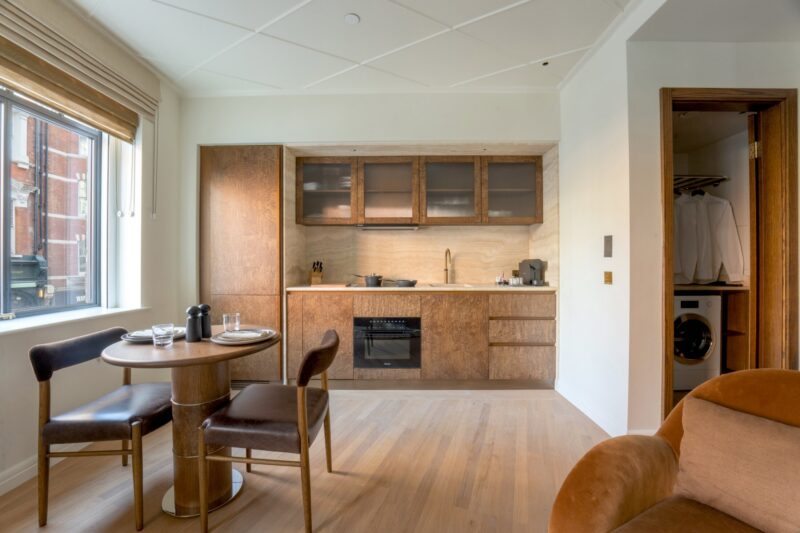
Refined living room interior with large window — an editorial view of a London serviced apartment

Serviced Apartments in London

The Complete Guide to Finding Your Perfect Stay

London hotel prices averaging £200+ per night have a way of making even the most enthusiastic traveller do a double-take. For a week-long stay, that’s £1,400 before you’ve paid for a single meal out.

Serviced apartments change that calculation entirely — offering the professional management and reliable standards of a hotel, combined with the space, privacy, and self-sufficiency of a proper home.

Read the guide

Photo by Robbie Duncan on Unsplash

What Are Serviced Apartments? (And Why Choose One in London)

A serviced apartment is a fully furnished, professionally managed property that combines the amenities of a hotel with the functionality of a private home. You get your own kitchen, your own living space, your own bedroom — and unlike a standard rental, someone else handles the cleaning, the linen, and the day-to-day management.

Professional management means consistent quality standards, a reliable point of contact if something goes wrong, and none of the uncertainty you sometimes get with private short-term rentals. The industry calls this a home away from home — and it’s a description that earns its keep.

Serviced apartments suit a wider range of travellers than most people assume — corporate professionals on extended assignments, families visiting for two weeks, tourists who want a neighbourhood base, and people relocating who need somewhere comfortable while they find permanent accommodation.

The sweet spot is typically seven nights or more. Most providers offer short stay (7–30 nights), medium stay (1–3 months), and long let (3+ months) options, each with different pricing structures and terms.

Serviced Apartments vs Hotels vs Airbnb — A Quick Comparison

Feature Serviced Apartment Hotel Airbnb / Short-Term Rental
Space 40–120 sq m (1-bed to 3-bed) 20–30 sq m (standard room) Varies widely
Kitchen facilities Full kitchen (most properties) None or limited Varies
Minimum stay Typically 7 nights 1 night 1–2 nights (varies)
Management consistency Professional, standardised Professional, standardised Variable — host-dependent
Approx. weekly cost £1,500–£2,600+ £1,400–£2,500+ (7 × nightly) £700–£2,000+
Housekeeping Weekly as standard Daily as standard Varies (often none)
Suited to long stays? Yes — optimised for 7+ nights No — costs compound quickly Possible, but inconsistent

Types of Serviced Apartments in London — From Studios to Three-Bedroom Homes

Walk through any London serviced apartment provider’s portfolio and you’ll find the same basic taxonomy: studio, one-bedroom, two-bedroom, three-bedroom, and occasionally something in the premium or penthouse tier.

Editorial living space with warm wood table and blue upholstered chair

Studio Apartments

20–30 sq m (roughly 215–320 sq ft). Everything is in one space: sleeping area, living area, and kitchenette. Ideal for solo travellers spending most of their time out of the apartment — efficient, affordable, and keeps overheads low.

Photo by Gian Paolo Aliatis on Unsplash

Neutral-toned bedroom with soft styling — representative of a one-bedroom serviced apartment

Most Popular Choice

One-Bedroom Apartments

40–55 sq m (430–590 sq ft). A proper separation between living and sleeping — which matters enormously for both work and rest. The most commonly booked option for good reason. Bed configurations typically include a king or double, occasionally a twin for colleagues sharing.

Photo by Point3D Commercial Imaging Ltd. on Unsplash

Softly lit bedroom with matching nightstands and warm tones — two-bedroom apartment atmosphere

Two-Bedroom Apartments

65–85 sq m (700–915 sq ft). Works well for families with children, two colleagues sharing costs, or anyone who simply wants more room. The cost per person drops significantly when two people split a two-bed versus booking separate studios. Some include two bathrooms.

Photo by Francesca Tosolini on Unsplash

Cosy bedroom with a bedside table and lamp — three-bedroom family apartment tone

Three-Bedroom Apartments

90–120 sq m (970–1,290 sq ft) — enough for a family of five or a small group of colleagues on an extended project. At the premium end, some three-bedroom properties include penthouse-level views, multiple bathrooms, and finishes that rival five-star hotels.

Photo by Franco Debartolo on Unsplash

Guest reading by a large window in a refined living space — penthouse and premium tier atmosphere

Penthouse & Premium Apartments

Superior furnishings, top-floor locations, premium Hypnos King mattresses, and concierge-level service. Pricing for these typically starts at £2,200/week in prime postcodes like Mayfair or Kensington. For executives, special occasions, or anyone who wants the best London has to offer without the formality of a hotel.

Photo by Toa Heftiba on Unsplash


What’s Included in a London Serviced Apartment?

This is one of the most common questions — and one of the most important to get right before you book. ‘Included’ can mean different things across different providers.

Standard Inclusions

Kitchen and Cooking Facilities

A kitchenette — common in studios and budget properties — typically includes a microwave, a mini-fridge, a kettle, and a two-ring hob. Functional, but limited.

A full kitchen, found in most one-bedroom and larger apartments, includes a full-size fridge-freezer, oven, hob, dishwasher, and a complete set of cookware, crockery, and utensils. If you’re planning to cook regularly, make sure you’re getting a full kitchen, not just a kitchenette — ask specifically if you’re not sure.

the-newman-kitchen

Housekeeping and Linen

Weekly cleaning and linen change is standard. Some providers offer daily housekeeping as an upgrade, which suits guests who prefer hotel-level service. For longer stays, mid-week towel changes are sometimes included automatically. In-house cleaning teams tend to deliver more consistent results than outsourced services.

Technology and Connectivity

Fast, reliable WiFi isn’t optional for most travellers today. Premium properties increasingly offer gigabit-speed broadband, which matters if you’re video-conferencing all day or have multiple devices running simultaneously. Smart TVs with streaming apps, USB charging points, and Bluetooth speakers are becoming common in mid-range and above properties.

hertford-street

Premium Extras and Concierge-Level Services

At the upper end of the market, the inclusions expand considerably. Premium bed quality — look for Hypnos mattresses, the same specification used by many five-star London hotels — makes a genuine difference for long-stay guests. Concierge services include restaurant bookings, theatre tickets, dry cleaning, and grocery delivery.

Airport transfers, welcome hampers, and dedicated account management for corporate clients are also available from specialist providers.

What’s Typically Not Included

Utilities note: Gas, electricity, and water are typically included in short and medium-stay rates. For long lets of three months or more, ask whether utilities are included or billed separately — and clarify the council tax position, as long-term residents may be liable.


Best Neighbourhoods for Serviced Apartments in London

London is a collection of villages, not a single city — and where you stay shapes your entire experience. The right neighbourhood depends on why you’re here, how you’re getting around, and what matters most to you on a typical day.

Aerial view over central London — establishing the West End neighbourhood
Photo by Call Me Fred on Unsplash

Covent Garden, Soho and the West End

Staying in the West End puts you at the centre of everything — theatre, restaurants, shopping, and some of London’s best transport connections. Covent Garden sits within walking distance of the Strand, the South Bank, and the City. Soho is unbeatable for restaurants and nightlife. The trade-off is noise and price. Best suited to tourists and short-stay visitors who want everything on their doorstep.

Mayfair and Belgravia

Mayfair is London’s most prestigious postcode. Premium weekly rates, exceptional finishes, and a neighbourhood that feels genuinely different — quieter, more refined, unmistakably upscale. Bond Street and Green Park tube stations. The proximity to Buckingham Palace, Hyde Park, and Knightsbridge is a genuine draw. These areas suit corporate executives and anyone for whom address matters as much as accommodation.

White stucco Georgian buildings along a Mayfair street on a sunny day
Photo by Ashleigh Joy Photography on Unsplash
People walking on a street near a white concrete building in South Kensington
Photo by Surya teja on Unsplash

Kensington and South Kensington

Probably the most well-rounded area for serviced apartments in London — particularly for families and longer stays. The Natural History Museum, Science Museum, and Victoria & Albert Museum are all within walking distance of each other. The Piccadilly and District lines run through here. Calm, residential, and genuinely pleasant to walk around with children.

Notting Hill, Bayswater and Portobello Road

The pastel-coloured townhouses, Portobello Road market on a Saturday morning, independent coffee shops and boutiques. Residential in a way that central London isn’t — ideal for longer-stay guests who want to feel like they live in London rather than visiting it. Bayswater is slightly more affordable, with easy access to Hyde Park and Paddington station (useful for Heathrow via the Elizabeth line). Earls Court further south offers competitive pricing on both the District and Piccadilly lines.

Row of pastel-coloured townhouses on a Notting Hill street
Photo by Gilley Aguilar on Unsplash
Red London bus on a Marylebone street — the West End boutique atmosphere
Photo by Thomas Konings on Unsplash

Marylebone and Fitzrovia

Marylebone High Street is one of London’s most pleasant shopping streets — independent bookshops, artisan food halls, and a village-like atmosphere five minutes from Oxford Circus. Fitzrovia, between Oxford Street and Bloomsbury, has a strong restaurant scene and easy access to both the West End and the City. Both areas work well for business travellers who need West End access without the noise of Soho.

Westminster

Big Ben, the Houses of Parliament, and St James’s Park are effectively on your doorstep. Westminster, St James’s Park, and Victoria stations are all nearby. Westminster is more of a daytime destination than a neighbourhood — best suited to short sightseeing stays and government or public sector professionals working in the area.

Aerial view over the Thames near Westminster and the Houses of Parliament
Photo by Niteesh Yadav on Unsplash
Bridge over a river with the London skyline in the background — Hammersmith riverside area
Photo by Yukon Haughton on Unsplash

Hammersmith

Hammersmith sits at the western edge of Zone 2 and offers a genuine value proposition: lower weekly rates than Kensington or Mayfair, strong transport links (the Piccadilly, District, and Hammersmith & City lines all converge here), and a lively riverside area with good restaurants and bars. For corporate travellers working in West London — media companies, tech firms, and broadcasters — it’s often a better base than central London.

Quick Neighbourhood Comparison

Neighbourhood Tube Zone Nearest Station(s) Best For Price Level
Covent Garden / Soho Zone 1 Covent Garden, Tottenham Court Rd Tourists, short stays £££££
Mayfair / Belgravia Zone 1 Bond Street, Green Park Corporate executives, luxury stays £££££
Kensington / South Kensington Zone 1–2 High St Kensington, South Kensington Families, longer stays ££££
Notting Hill / Bayswater / Portobello Zone 1–2 Notting Hill Gate, Bayswater, Paddington Tourists, medium stays £££–££££
Marylebone / Fitzrovia Zone 1 Baker Street, Oxford Circus Business travellers, leisure ££££
Westminster Zone 1 Westminster, Victoria Sightseeing, public sector ££££
Earls Court Zone 2 Earls Court Value-focused, longer stays £££
Hammersmith Zone 2 Hammersmith Corporate (West London), value £££


How to Book a Serviced Apartment in London

Pricing is the question most people have and the one most providers are frustratingly vague about online. Here’s a clear picture — followed by a step-by-step walkthrough of the booking process.

Approximate Weekly Rates by Apartment Type and Location

Apartment Type Location Tier Approx. Weekly Rate
Studio / 1-bedroom Prime (Mayfair, Kensington) £1,900–£2,400
Studio / 1-bedroom Mid-range (Marylebone, South Kensington, Notting Hill) £1,561–£1,638
Studio / 1-bedroom Value (Earls Court, Hammersmith) £1,200–£1,500
2-bedroom Prime £2,400–£3,000+
2-bedroom Mid-range £1,757–£1,974
2-bedroom Value £1,400–£1,750
3-bedroom / Premium Prime £2,618–£3,500+
3-bedroom / Premium Mid-range £2,198–£2,618
Penthouse Prime £3,000–£5,000+

Seasonal Pricing

Rates peak in summer (June–August), around New Year, and during major events such as Wimbledon and school holidays. Shoulder season (October–November and January–March) can yield 15–25% lower weekly rates.

Short vs Long Stay

Short stay (7–30 nights) is typically priced at the standard weekly rate. Medium stays (1–3 months) often attract a 10–15% discount. Long lets (3+ months) can reduce the effective weekly rate by 20–30%.

Book Direct

Third-party platforms charge providers a commission (often 15–20%). Booking direct removes that cost. If a provider offers a Lowest Rate Guarantee, take it at face value — and ask them to match or beat any lower rate you find elsewhere.

Editorial kitchen and dining area — a considered check-in moment
Photo by Anand Kumar on Unsplash

A Step-by-Step Booking Guide

1

Decide on Your Requirements

Start with three fundamentals: which area of London do you need to be in or near? What size apartment do you need — studio, one-bed, two-bed? And what’s your weekly budget? Having clear answers to these three questions saves a lot of time browsing properties that aren’t right.

2

Search and Compare Options

Start with provider websites directly. Aggregator listings aren’t always up to date, and the rates shown may not reflect the best available price. Look beyond the headline rate — check what’s included (utilities, WiFi, cleaning), what the minimum stay is, and whether the photographs are recent and accurate.

3

Book Direct for the Best Rate

Call or email the reservations team if the online booking system doesn’t show availability for your dates — a direct conversation often uncovers options that don’t appear online. Ask about check-in and check-out flexibility (standard check-in is typically from 3pm, check-out by 11am), current promotions, and long-stay discounts.

4

Understand Cancellation Policies

Terms range from fully flexible (cancel up to 48 hours before arrival for a full refund) to non-refundable discounted rates. Prioritise flexible cancellation when plans are uncertain — particularly for corporate bookings where trip dates frequently shift. Before confirming, also check payment terms, whether utilities are included or capped, and for longer stays, the council tax position.

5

Check-in and What to Expect on Arrival

Professional operators typically provide a detailed pre-arrival information pack covering access instructions, parking (if applicable), and local area information. On arrival, the apartment should be clean, fully stocked with linen and towels, and all appliances in working order. If anything isn’t right on arrival, contact the management team immediately — reputable providers have 24/7 support for exactly this reason.

Accessibility

Accessibility varies significantly across London’s serviced apartment stock, particularly in older Victorian or Edwardian conversions. Confirm lift availability, step-free access from the street, and whether the bathroom has a walk-in shower or requires stepping over a bath — directly with the provider before booking. Providers will always be able to advise.

Book direct. It’s almost always the fastest route to the best available rate, the most flexible terms, and a direct relationship with the people managing your accommodation.

Frequently Asked Questions

How is a serviced apartment different from a hotel or Airbnb?

A serviced apartment is professionally managed with standardised quality controls, includes a kitchen and considerably more space than a hotel room, offers weekly housekeeping as standard, and typically has a seven-night minimum stay. Compared to Airbnb, the key difference is management consistency: vetted cleaning teams, 24/7 support, and a legal framework that protects both parties.

Who are serviced apartments best suited for?

Corporate professionals on extended assignments, families visiting London for two weeks, tourists who want a neighbourhood base rather than a hotel corridor, and people relocating who need somewhere comfortable while they find permanent accommodation. The sweet spot is typically seven nights or more.

What’s included as standard?

Free high-speed WiFi, weekly housekeeping, fresh towels and linen, a fully equipped kitchen or kitchenette, a television, a hairdryer, and an iron with ironing board. 24/7 phone support is increasingly standard among professional operators.

What’s typically not included?

Parking is not standard in the vast majority of London serviced apartments. Council tax on long lets of 3+ months classified as a primary residence may fall to the occupant. Daily housekeeping is typically an upgrade at additional charge.

How much do serviced apartments in London cost?

Value areas (Earls Court, Hammersmith): £1,200–£1,500/week. Mid-range (Marylebone, South Kensington, Notting Hill): £1,561–£1,974/week. Prime (Mayfair, Kensington): £1,900–£3,000+/week. Penthouses: £3,000–£5,000+/week.

Which neighbourhood should I choose?

South Kensington for families (museums, parks, calm streets); Mayfair or Marylebone for corporate professionals; Notting Hill or Bayswater for a residential feel on a medium stay; Hammersmith or Earls Court for value with strong transport links.

Are discounts available for longer stays?

Medium stays (1–3 months) often attract a 10–15% discount. Long lets (3+ months) can reduce the effective weekly rate by 20–30% compared to short-stay pricing.

Should I book direct or via a platform?

Booking direct typically secures the lowest available rate, the most flexible terms, and a direct relationship with the management team. Third-party platforms charge providers a 15–20% commission, which is either absorbed into the rate or passed on to the guest.

What about accessibility?

Accessibility varies significantly, particularly in Victorian or Edwardian conversions. Confirm lift availability, step-free access from the street, and whether the bathroom has a walk-in shower or requires stepping over a bath — directly with the provider before booking.